How Does Cinna Harmony Work? The Idea Behind the Formula
Written by the Cinna Harmony editorial team
Last updated · Who reviewed this page · How we write and review
Cinna Harmony is meant to give daily Blood Sugar Support.
It pairs chromium 0.7 mcg with a 200 mg blend of 22 ingredients, including gymnema, Panax ginseng and African mango. It does not replace drugs your doctor prescribes.
How is Cinna Harmony supposed to work?
Cinna Harmony is meant to give daily Blood Sugar Support, the one claim printed on its label. The formula pairs 0.7 mcg of chromium with a 200 mg blend of 22 ingredients, some of which have been studied for blood sugar.
That research tested single ingredients, mostly at far larger doses. Nobody has tested the finished drops, so the mechanism below is the intended idea, not a proven effect.
The Cinna Harmony formula idea, step by step
The Cinna Harmony plan runs in five steps. Each one matches a group of label ingredients or a line of the directions.
- 1
One liquid serving
Shake the bottle, then take 1 or 2 droppers. Each 1 ml serving carries every label ingredient.
- 2
A trace of chromium
Chromium 0.7 mcg, a mineral studied alongside insulin, at 2% of the Daily Value.
- 3
Herbs from blood sugar research
Gymnema, Panax ginseng and African mango sit in the blend with no single amounts.
- 4
Caffeine and weight-style extracts
Guarana and green tea add caffeine; coleus, capsicum and raspberry ketones come from weight products.
- 5
A steady daily habit
The seller frames the drops as one part of a daily routine, not a fix on their own.
What do “insulin sensitivity” and “carbohydrate metabolism” mean for Cinna Harmony?
They are sales-page words, not label claims. The Cinna Harmony bottle prints only “Blood Sugar Support,” with an asterisk that leads to the FDA statement.
Supplements may make structure/function claims like that one without FDA review, as long as the statement appears (FDA, 2024).
Insulin sensitivity means how well your cells respond to insulin. Carbohydrate metabolism means how your body breaks down and uses carbs. No study shows that Cinna Harmony changes either one.
What the label does not claim
- It does not claim to lower blood sugar or A1C.
- It does not claim to treat, cure or prevent diabetes.
- It does not claim weight loss.
- It does not claim FDA approval; the factory is FDA registered, which is a different thing.
Cinna Harmony and chromium: what the insulin research shows
Cinna Harmony gives 0.7 mcg of chromium per ml, a trace mineral studied for how the body uses insulin. NIH says reviews found a small, unclear benefit for blood sugar in people with diabetes (NIH ODS, 2022).
Those trials used about 200 to 1,000 mcg a day. The label amount is about 1/300 to 1/1,400 of that range.
Pooled trials saw HbA1c fall about 0.55 points, and the authors said long-term benefit still needs study (Suksomboon et al., 2014). Other reviewers advised people with type 2 diabetes not to take chromium for blood sugar control (Landman et al., 2014).
Cinna Harmony herbs and blood sugar: what studies found
Five Cinna Harmony blend herbs have some human or lab research behind them. The findings are small, and none used these drops.
The single amounts are not printed, so no herb can be matched to its study dose. Doses are compared on the Cinna Harmony ingredients page.
Gymnema
600 mg a day for 12 weeks did not change insulin sensitivity or insulin release (Zuniga et al., 2017).
Panax ginseng
16 trials: a small fasting-sugar drop and no HbA1c change (Shishtar et al., 2014).
African mango
One branded extract at 150 mg twice daily; later reviewers rated the trials poor (Onakpoya et al., 2013).
Eleuthero
Blood sugar effects come from lab and animal work; human data are limited (MSKCC, 2022).
Astragalus
Not enough reliable evidence for any health condition (NCCIH, 2025).
Maca
Studied at grams a day for sexual function, not blood sugar (MSKCC, 2023).
Cinna Harmony claims, ingredients and evidence strength
The table links each Cinna Harmony claim to the ingredients behind it. The last column is our editorial read, not a score from any study.
Our article on gymnema, chromium and African mango study doses goes deeper on the numbers.
| Claim | Ingredient | What research found | Evidence strength |
|---|---|---|---|
| Blood Sugar Support (label) | Chromium 0.7 mcg | HbA1c fell about 0.55 points at 200-1,000 mcg in diabetes trials | Low; dose about 1/300 of trials |
| Blood Sugar Support (label) | Gymnema | No change in insulin sensitivity at 600 mg a day | Low; share not printed |
| Blood Sugar Support (label) | Panax ginseng | Small fasting-sugar drop, no HbA1c change | Low; aerial parts, not root |
| Blood Sugar Support (label) | African mango | One branded-extract trial; reviews rated it poor | Very low |
| Insulin sensitivity (sales page) | No ingredient shown to do this | The cited gymnema trial found no change | Not established |
| Carbohydrate metabolism (sales page) | Whole 200 mg blend | No study of the finished drops | Not established |
What do guarana and green tea add to Cinna Harmony?
Guarana and green tea add caffeine to Cinna Harmony. The label does not print how much, so the stimulant share of each serving is unknown.
The FDA cites 400 mg of caffeine a day as an amount most healthy adults handle without harm (FDA, 2024). Too much can bring a fast heartbeat, shakiness and poor sleep.
Neither ingredient is tied to a blood sugar result in our sources, and the label does not explain why they are in the formula. If coffee already makes you jittery, count the drops toward your daily caffeine.
Do Cinna Harmony liquid drops absorb better than capsules?
Nobody has published a test of that for Cinna Harmony. No source in our list compares these drops with a capsule or a tablet.
The label says to place the liquid in the mouth and swallow. That makes it an oral supplement like any other, just in liquid form.
A liquid can feel easier for people who dislike pills. That is a matter of comfort, not a proven boost in effect.
Has Cinna Harmony itself been studied?
No. No clinical study of the finished Cinna Harmony formula has been published, and every finding on this page comes from single-ingredient trials.
The FTC notes that studies on a different dose or formula may not support a product’s claims (FTC, 2022).
- Chromium: 0.7 mcg against trial doses of 200 to 1,000 mcg.
- Gymnema: the whole 200 mg blend is a third of one 600 mg study dose.
- Maca: studied at 1.5 to 3.5 g a day, far above any share of 200 mg.
- Blend herbs: no single amounts, so no fair dose comparison.
Can Cinna Harmony replace diabetes medication?
No. Cinna Harmony is a dietary supplement, not a diabetes medicine, and it never replaces insulin, metformin or any drug your doctor prescribed.
The ADA says supplements such as chromium or cinnamon are not recommended for blood sugar benefits (ADA, 2026). NCCIH warns against swapping medical treatment for an unproven product (NCCIH, 2018).
How Cinna Harmony fits a daily routine
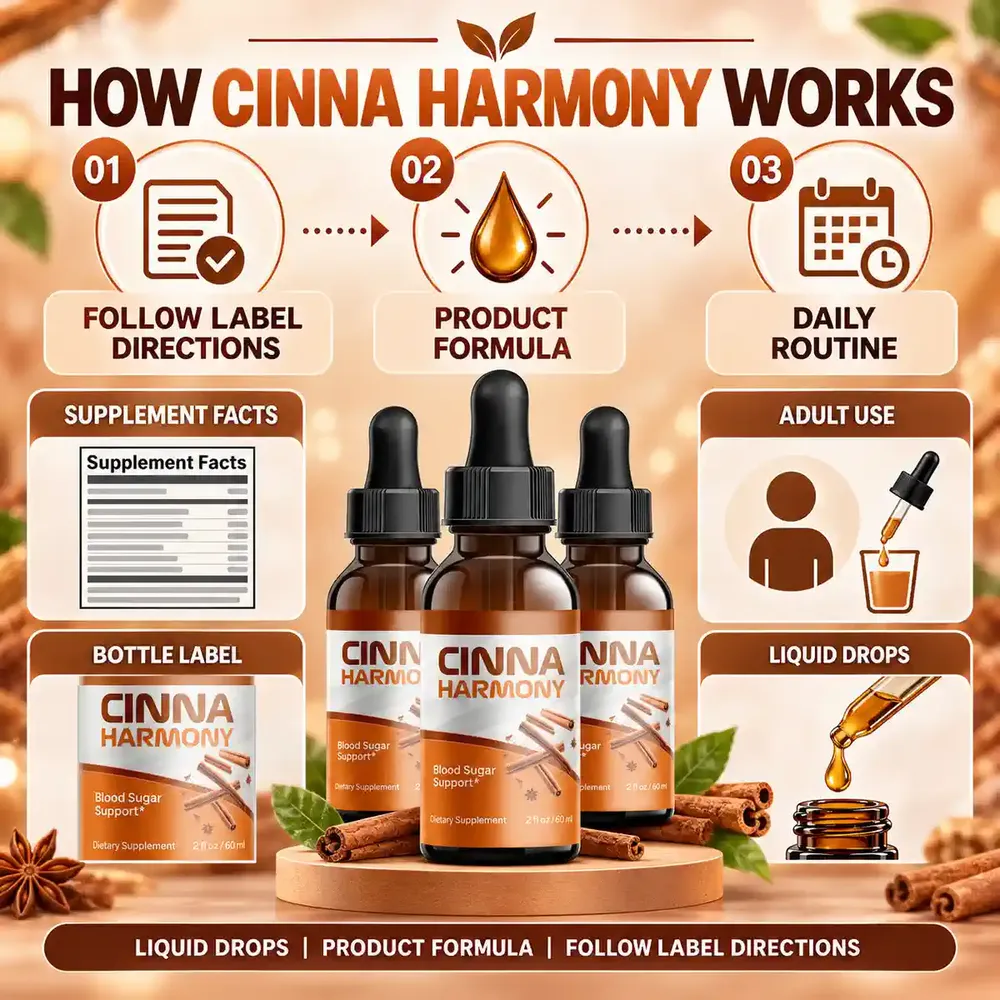
Cinna Harmony is meant to be one small daily habit next to the meals, movement and checkups you already have. The seller graphic puts “follow label directions” first for that reason.
Dosing steps and habit ideas are on the how to take Cinna Harmony page. What the claim means in daily life is on the Cinna Harmony benefits page.
Shake well, then 1 or 2 droppers a day, placed in the mouth and swallowed.
One bottle lasts about 30 to 60 days, depending on your dose.
Adults 18+; ask a physician first if pregnant, nursing or living with a condition.
How Cinna Harmony works: common questions
Questions people type into Google and Bing, answered from the label and the sources on this page.
How is Cinna Harmony supposed to work?
The label claims Blood Sugar Support. The formula pairs a small amount of chromium with 22 blend ingredients, some studied for blood sugar, but the finished drops have never been tested.
Can drops improve insulin sensitivity?
No study shows that Cinna Harmony does. In a 12-week gymnema trial, 600 mg a day left insulin sensitivity unchanged.
Do herbal drops lower blood sugar?
Cinna Harmony makes no such claim, and the ADA does not recommend herbs or supplements for blood sugar control. Some single herbs showed small fasting-sugar changes at much larger doses.
How does chromium affect insulin?
Chromium is a trace mineral studied alongside insulin. Reviews found a small, unclear benefit in people with diabetes, at 200 to 1,000 mcg a day.
How does gymnema reduce sugar cravings?
None of our cited sources measured cravings. The gymnema trial we cite looked at weight and insulin, not appetite for sweets.
Do liquid supplements absorb better than pills?
Nothing published compares Cinna Harmony drops with a capsule. The label says to place the liquid in the mouth and swallow, like any oral supplement.
Is there any clinical study on Cinna Harmony itself?
No. No study of the finished formula has been published; the research covers single ingredients.
What does “carbohydrate metabolism support” mean?
It is sales-page wording about how the body handles carbs. It is not a measured result and is not printed on the bottle.
Can a supplement replace diabetes medication?
No. NCCIH says not to swap medical treatment for an unproven product, so keep taking what your doctor prescribed.